Pets breathe the same air as the people they live with, and many spend more hours of the day at home, often at floor level. That makes an animal that becomes unwell a possible early clue to CO exposure in the building, though never a substitute for an alarm.
- A pet that becomes unwell indoors can be an early clue to a CO problem in the home, but it is not a detection method.
- Unusual pet lethargy or illness, especially alongside human symptoms, is a potential early warning sign.
- Evacuate all household members and pets together if CO exposure is suspected.
- Seek both emergency medical care for humans and veterinary care for affected pets.
Why Pets May Show Symptoms First
Every occupant of a room breathes the same CO concentration, so the difference between a pet and a person is not the air but the hours spent in it. A pet that is home all day accumulates more time in that air, which is one reason unusual lethargy or illness in an animal is worth taking seriously. Veterinary guidance published by Hill’s is blunt that cats and other pets are at just as much risk as people [1].
Symptoms to Watch For
Unusual lethargy, vomiting, difficulty breathing, or loss of coordination in a pet, especially occurring alongside similar human symptoms, warrants immediate evacuation and veterinary/medical attention.
Hill’s lists the signs of sudden, acute CO poisoning in cats as loss of energy or acting excessively sleepy, red gums or red skin, incoordination or clumsiness, seizures, and difficulty breathing. Lower-level, longer-term exposure can look different: vomiting, loss of appetite, cough, low energy, and in some cases deafness or blindness [1].
A veterinarian quoted by dvm360 adds drowsiness, depression, weakness, coma, and a bright red color to the skin or gums for pets generally [2]. Hill’s also notes that cats with pre-existing heart or lung problems are at increased risk [1].
Recovery is not always the end of it. PetMD notes that nervous system signs may be seen in some animals weeks after the initial recovery [3], so a pet that seemed to bounce back still warrants a follow-up conversation with the vet.

What to Do
If you suspect CO exposure affecting a pet, evacuate all household members and pets together, then seek both emergency medical care for humans and veterinary care for the pet.
Hill’s advises taking a cat to the nearest emergency vet right away if you suspect CO poisoning [1]. For questions on the way, Pet Poison Helpline, a 24/7 animal poison control service that covers carbon monoxide, can be reached at (855) 764-7661; a per-incident fee applies [4].
Treatment starts with fresh air and oxygen. The veterinarian quoted by dvm360 describes moving the animal away from the source first, then giving supplemental oxygen, which speeds the elimination of CO, by facemask, hood, nasal cannula, oxygen cage, or breathing tube. Hyperbaric oxygen can be considered for the most severe cases where it is available [2].
One diagnostic detail is worth knowing as an owner. A standard pulse oximeter is not useful in CO poisoning, because it registers CO-bound hemoglobin the same as oxygen-bound hemoglobin and so overstates the oxygen in the blood. Confirming exposure takes a blood gas run on a co-oximeter [2].

Why a Pet Can Register a Problem Before the People Do
Pets tend to be in the house continuously, often at floor level, and frequently in rooms that people pass through rather than occupy. A pet may therefore accumulate more exposure in the same building simply by being present for more of the day in the places where a fault is developing.
Body size may contribute as well. Smaller animals generally have faster metabolic and breathing rates than the people they live with, which could mean effects appear sooner in them than in an adult in the same room. The veterinary sources cited here do not establish that pets reliably show signs first, so treat an animal as a possible early signal, never as an all-clear.
Reading the Signal Without Over-Reading It
The value of a pet as an indicator lies in the pattern rather than in any single episode. An animal that seems unwell indoors and improves once outside, or that is affected at the same time as other animals in the household, describes something about the building rather than about the animal. This is not only a theoretical point: a physician who described 26 patients with chronic, unrecognized CO exposure in a primary care practice reported that exposed household pets provided an important clue to the diagnosis in some cases [5].
The limits are worth holding onto too. Pets become unwell for many ordinary reasons that have nothing to do with combustion appliances, and waiting to see whether an animal reacts is not a detection strategy. A pet can prompt you to investigate; it cannot tell you that nothing is wrong.
What to Do If You Suspect the House Rather Than the Animal
If several people or animals in a home feel unwell together, the sensible order of operations is to get everyone, pets included, out into fresh air first and to seek help from outside the building rather than investigating from inside it. Leaving is the step that does not depend on being right about the cause.
When you do speak to a vet, mention the household context explicitly, including whether people have felt unwell and whether any combustion appliance has been behaving unusually. That framing changes what a clinician is looking for, and it is the sort of detail that is easy to leave out when the animal is the reason for the visit.
Protecting Pets Starts With the Household Precautions
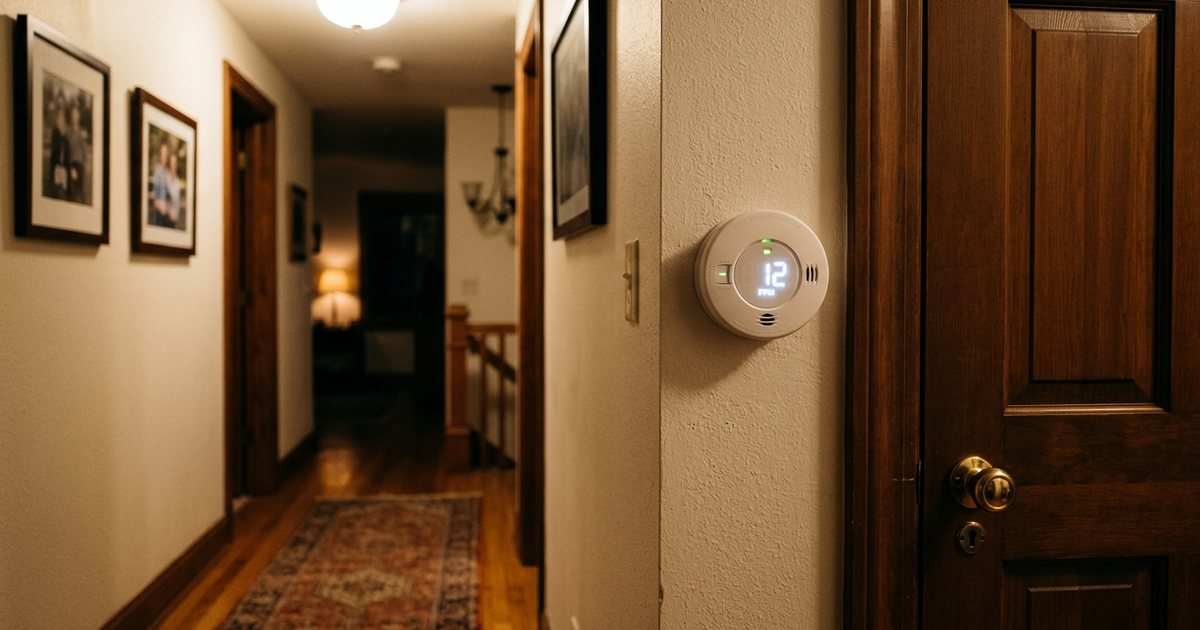
The practical protections for a pet are the same ones that protect the people. Hill’s recommends a CO detector on every level of the home with batteries checked twice a year, yearly servicing of fuel-burning appliances such as furnaces, boilers, and water heaters, and never running a generator indoors or less than 20 feet from any window, door, or vent [1].
The same guidance warns against running gas engines in a closed area. That matters for any pet that spends time in a garage, where a running car or generator is the kind of source an animal cannot walk away from.
FAQ
Can my dog really detect CO exposure before I notice symptoms myself?
A pet may show signs sooner, and unwell pets have helped doctors recognize CO exposure in the people they live with [5], but this isn’t a reliable detection method. Always rely on a properly installed CO detector as your primary warning system.
Do household carbon monoxide alarms protect pets as well as people?
An alarm responds to the air in the room rather than to who is breathing it, so it serves everyone present. Because effects can appear in a small animal sooner, the alarm may not be the first thing you notice.
Should I get a separate detector for the room my pet sleeps in?
Coverage is usually described in terms of levels of the home and sleeping areas, and a pet’s regular sleeping spot is reasonable to count as one of those when deciding where units go.
Never rely on observing pet behavior as your primary CO detection method — use a proper detector.
References
- Wooten S. Carbon Monoxide Poisoning in Cats: Signs & Prevention. Hill’s Pet Nutrition (2022)
- Top 6 veterinary questions about carbon monoxide poisoning. dvm360 (2011)
- Carbon Monoxide Poisoning in Cats. PetMD
- Carbon Monoxide. Pet Poison Helpline
- Kirkpatrick JN. Occult carbon monoxide poisoning. West J Med (1987). PMID 3825110
These statements have not been evaluated by the Food and Drug Administration. This information is not intended to diagnose, treat, cure, or prevent any disease. Content is for informational purposes only and is not medical advice; consult a qualified healthcare provider before starting any supplement. As an Amazon Associate we earn from qualifying purchases.
